
 16 July 2026
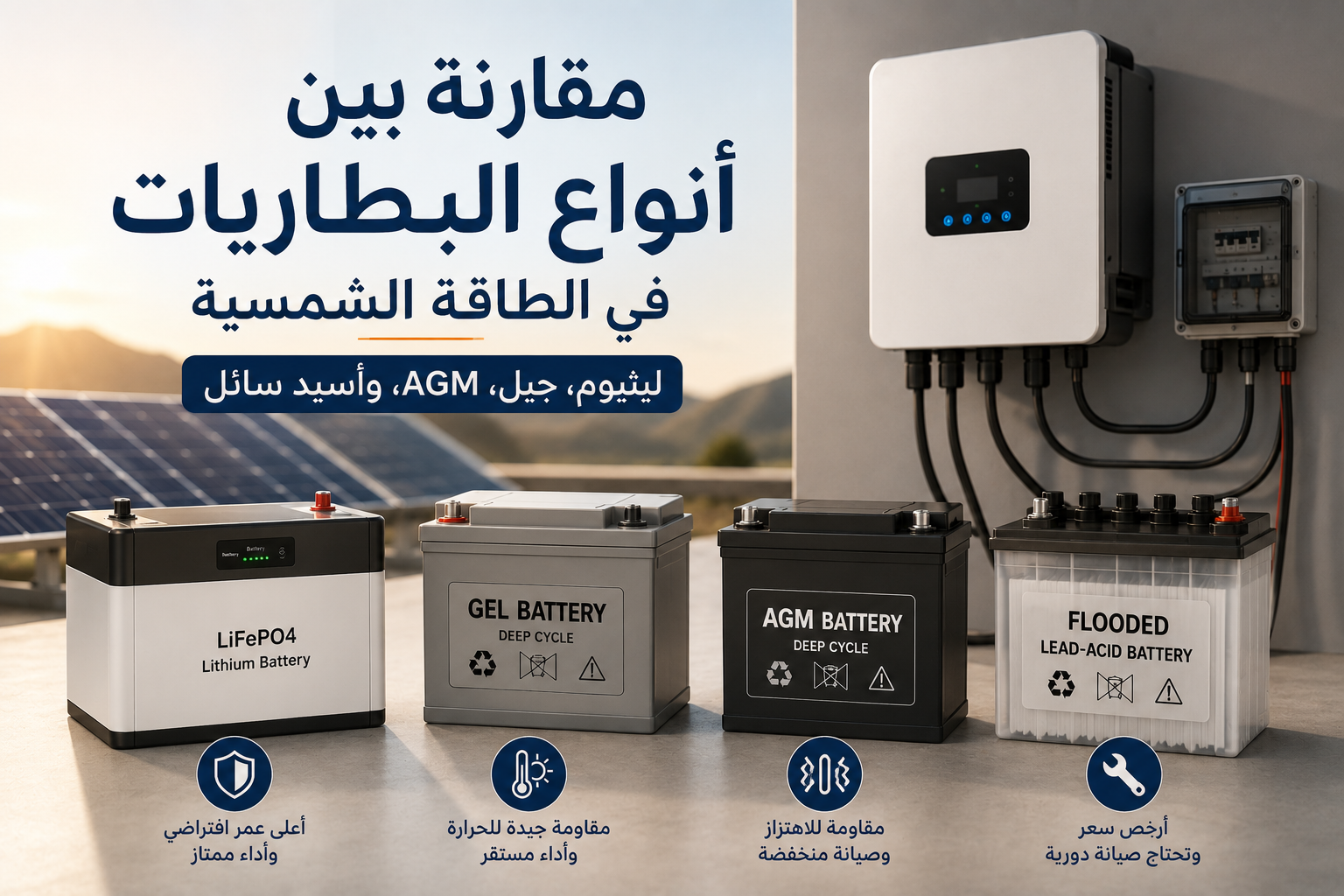
Comparing Solar Battery Types: Lithium, Gel, AGM, and Flooded Lead-Acid
Introduction: The Battery Is the Heart of the Storage System
If your system relies on storing electricity (whether a fully "off-grid" system or a hybrid system with backup during power outages), the battery is the most important decision you'll make after the panels themselves. Choosing the wrong type could mean replacing the battery every 2-3 years instead of it lasting 10 years or more.
In this article we'll give a simple comparison of the 4 most common battery types used in the market.
First: Lithium Batteries (LiFePO4 / LFP)
The newest and most widely used type in new installations today. It uses Lithium Iron Phosphate (LiFePO4) chemistry, the safest and most stable of the various lithium technologies.
Advantages:
Very high number of charge cycles: Roughly 4,000 to 8,000 charge/discharge cycles, meaning a lifespan that can reach 10-15 years or more with daily use.
Deep discharge capability: You can use 80% to 100% of the battery's capacity without damaging it, unlike other types that require leaving a large portion unused.
Very high charge/discharge efficiency: Reaching over 95%, meaning much less electricity loss.
Lightweight: Much lighter than traditional batteries of the same capacity.
Almost no maintenance: No need for periodic inspection or adding water like traditional batteries.
Smart protection system (BMS): Comes with an electronic circuit that monitors temperature and voltage and protects the battery from overcharging or over-discharging.
Disadvantages:
Higher upfront price compared to traditional types.
Sensitive to extreme cold (below freezing), needing an internal heating system in very cold regions (rarely an issue in Egypt or Saudi Arabia).
Second: Gel Batteries
A type of sealed lead-acid battery (VRLA), but instead of liquid, the electrolyte is in a semi-solid gel form.
Advantages:
Good resistance to high heat, making it an acceptable choice in hot climates.
Safe and fully sealed with no leakage or need for special ventilation.
Better performance than AGM in repeated deep discharge.
Disadvantages:
Limited number of cycles: Usually only about 1,000 to 1,200 cycles at 50% discharge.
Much lower safe discharge percentage: Usually you need to leave about 50%-70% of its capacity unused to preserve its lifespan.
Requires charging precision: Incorrect or fast charging quickly shortens its lifespan.
Much shorter lifespan than lithium, usually 4 to 6 years.
Third: AGM Batteries (Absorbent Glass Mat)
Another type of sealed lead-acid battery, but the electrolyte is absorbed in glass fiber mats instead of gel.
Advantages:
Relatively low price compared to lithium and gel.
Good vibration resistance, suitable for installations with movement or vibration.
Safe and sealed, with no periodic water maintenance.
Disadvantages:
Fewer cycles than gel and lithium: Usually only 300 to 1,000 cycles at 50% discharge.
More sensitive to high heat than gel, an important drawback in Egypt's and Saudi Arabia's climate.
Short lifespan: Usually 3 to 5 years with daily use.
Fourth: Traditional Flooded Lead-Acid Batteries
The oldest and cheapest type, requiring periodic monitoring and maintenance by adding distilled water, plus proper ventilation for the installation location.
Advantages:
The cheapest price by far.
Spare parts and service centers available almost everywhere.
Disadvantages:
Requires continuous periodic maintenance (regular water checking and topping up).
Very short lifespan and limited number of cycles.
Not 100% safe, since it emits gases during charging and needs good ventilation.
Quick Comparison Table
Number of charge cycles: Flooded lead-acid lowest, then AGM (300-1000), then gel (1000-1200), then lithium far ahead (4000-8000+)
Safe discharge percentage: Flooded lead-acid and AGM about 50% — gel about 50-70% — lithium up to 80-100%
Approximate lifespan: Flooded lead-acid 2-3 years — AGM 3-5 years — gel 4-6 years — lithium 10-15+ years
Periodic maintenance: Flooded lead-acid needs regular maintenance — the rest are nearly maintenance-free
Performance in Egypt/Saudi Arabia heat: Lithium and gel perform better than AGM and flooded lead-acid
Upfront price: Flooded lead-acid cheapest, then AGM, then gel, then lithium highest upfront (but effectively the cheapest over its lifespan)
Which Is Best Suited for Egypt's and Saudi Arabia's Climate?
The high heat most days of the year in our region directly affects the lifespan of traditional batteries (AGM in particular is clearly affected). Lithium is the best option in terms of heat performance and lifespan, followed by gel as a middle option for those seeking a lower upfront cost with good heat tolerance.
In terms of total cost over 10 years (including frequent replacement of cheaper types), lithium usually turns out to be the better value overall, despite its higher upfront price.
Leading Brands
MUST (Must Power / Must Energy): A Chinese company specializing in LiFePO4 lithium batteries, hybrid inverters, and UPS systems, with a strong presence in Middle East and African markets at competitive prices and good warranties.
Sinopoly: One of the oldest and largest manufacturers of LiFePO4 lithium battery cells in the world, headquartered in Hong Kong with factories in China, offering large-capacity cells (from 40Ah to 400Ah) with warranties up to 10 years.
Veichi: A Chinese company known primarily for inverters and industrial motors, now also a manufacturer of LiFePO4 lithium batteries (both wall-mounted and stackable), with capacities starting around 5 kWh and reaching hundreds of kWh for large projects.
Dyness: One of the best-known lithium battery brands for solar power globally, widely available in Egypt and Saudi Arabia, known for high quality and compatibility with most hybrid inverter types.
Sako: A Chinese company specializing in integrated systems (lithium batteries + inverter + panels), offering lithium batteries with up to 6,000 charge cycles, compatible with most inverter brands on the market.
Frequently Asked Questions
Can you replace a flooded lead-acid battery with a lithium battery in the same system? You generally need to make sure the inverter or charge controller has a dedicated lithium setting, since the charging method differs from lead-acid. If the device is old and lacks this setting, you may need to replace it or add a suitable control unit.
Are lithium batteries really safe? Yes, especially the LiFePO4 type, considered the most stable and safest of all lithium types, equipped with an electronic protection system (BMS) that continuously monitors temperature and voltage.
Can I mix two different battery types in the same system? No, in general it's not recommended to mix different types or ages of batteries in the same bank, as this affects charge/discharge balance and shortens the lifespan of all the batteries.
Conclusion
If your budget is limited and you need a temporary solution or light usage, AGM or flooded lead-acid may serve you. But if you're planning a long-term system and want the lowest actual cost over the years along with the best safety and performance in summer heat, lithium (LiFePO4) batteries are currently the smartest choice for most residential and commercial projects.