
 20 June 2026
Specific Applications: Solar Energy in Our Daily and Practical Life
So far we've covered the basics of solar energy, the differences between systems, and how to maintain them. In this article, we'll look at solar energy in a more practical way: how it's used across different sectors, from agricultural land to the villa, and from the factory to the hotel.
Each application has its own nature and requirements, and we'll explain why solar energy is a fitting solution in each of these cases.
1. Solar Irrigation for Farms and Agricultural Land
One of the applications that saves real money for farmers and landowners, especially in places far from the electricity grid.
The Traditional Problem
Much agricultural land is far from electricity, so farmers rely on diesel generators to run irrigation pumps, which means constant fuel costs and daily expenses that significantly raise the cost of agricultural production.
The Solar Energy Solution
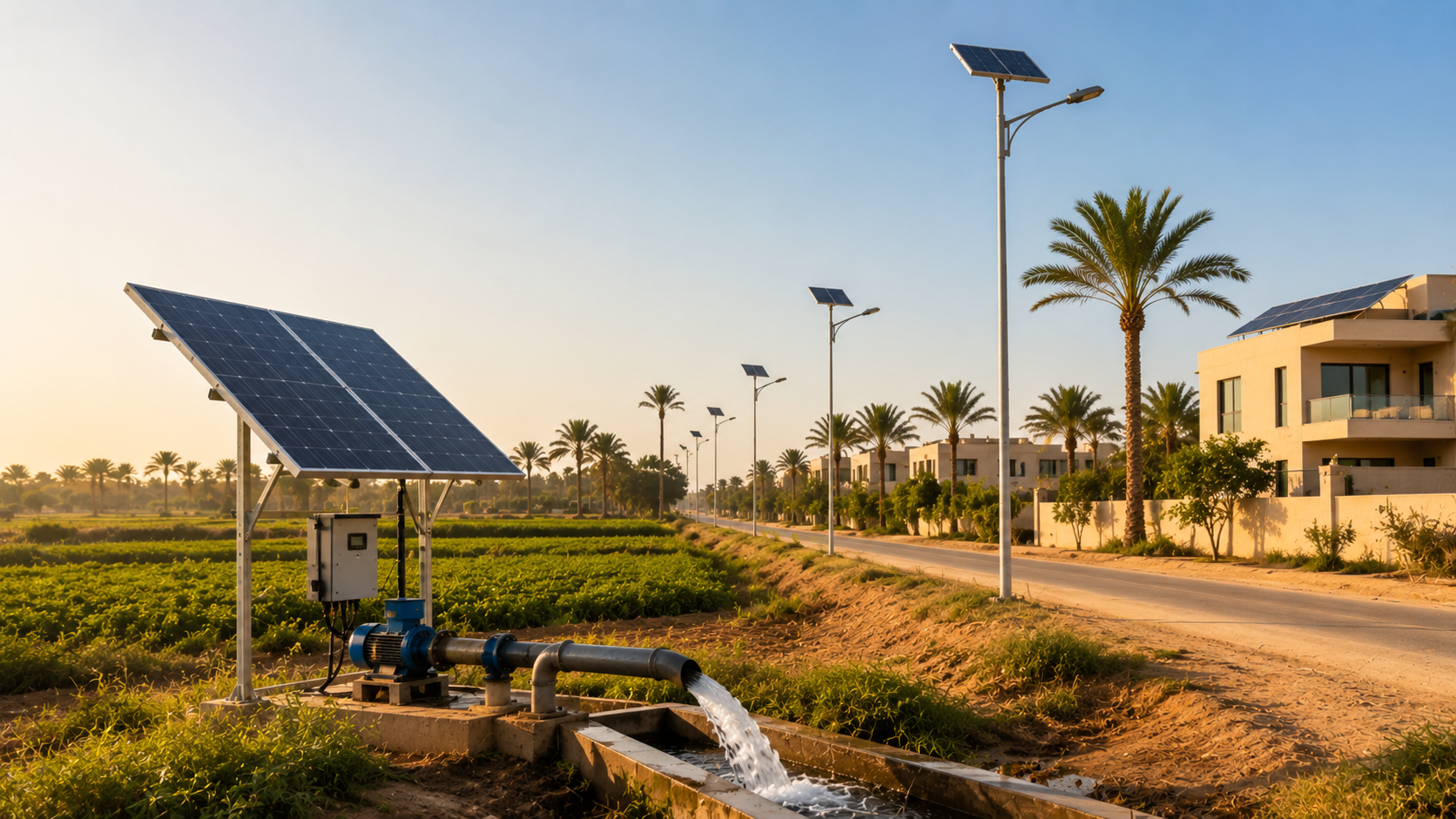
A simple Off-Grid system runs the irrigation pump directly from the sun, with no need for diesel or grid electricity at all.
Key benefits:
- Complete savings on diesel or fuel costs
- Automatic operation throughout the daylight hours, which matches irrigation needs most of the time
- Very simple maintenance compared to diesel generators, which need costly periodic servicing
- An ideal solution for land that is far from any electricity grid
Note: If irrigation is needed at times outside of sunlight hours, simple storage batteries can be added to cover the gap.
2. Solar Street Lighting Poles for Streets and Compounds
Street lighting is one of the applications that consumes electricity continuously every night, putting a heavy load on the electricity bill in compounds and large residential areas.
How Does It Work?
A solar lighting pole has a small solar panel mounted on top, and a built-in battery that stores electricity during the day. As soon as darkness falls, the light turns on automatically using the stored energy.
Benefits
- Each pole operates independently, meaning there's no need to run long electrical cables between poles, which saves significant wiring costs in new projects
- Very suitable for compounds and projects far from electricity infrastructure
- Fully automatic operation (a light sensor turns the lamp on and off without any human intervention)
- Significant savings on the electricity bill for the entire project
Who Needs This Type?
- New residential compounds
- Agricultural roads and areas far from the public lighting grid
- Factories and facilities with large outdoor areas that need lighting
3. Solar Energy for Factories and Industrial Facilities
Factories are among the largest electricity consumers, which makes them one of the sectors that benefits most from switching to solar energy due to the scale of the savings.
Why Are Factories Strong Candidates for Solar Energy?
- Their electricity consumption is very high and continuous, meaning monthly savings are large and noticeable quickly
- Most factories have large roof areas or land suitable for installing a large number of panels
- Working hours at most factories align with daylight hours, meaning electricity usage happens around the same time as solar power generation
The Right System for Factories
This is usually a large-capacity On-Grid system, or a Hybrid system if the factory needs complete production continuity and can't afford a stoppage during a power outage (such as sensitive production lines or equipment that must keep running).
Additional Benefits
- Continuously reducing the factory's operating costs over the long term
- Improving the facility's image as one that relies on clean energy, which has become an important factor in many export contracts and environmental certifications
4. Solar Energy for Villas and Residential Homes
This is the most common application and the closest to people's daily lives, and the first question often asked is: "Is it actually worth installing in my house?"
Why Are Villas and Homes Strong Candidates?
- Electricity consumption in villas is relatively high due to air conditioners and numerous household appliances
- Villa roofs are usually available and large enough to install a suitable system
- Monthly bill savings are noticeable and quick, especially with periodic increases in electricity prices
Which System Suits a Villa?
- If electricity in the area is stable: an On-Grid system will deliver excellent bill savings at a reasonable cost
- If there are frequent power outages in the area: a Hybrid system will ensure continuity for important appliances (air conditioning, refrigerator, internet) during outages
- If the villa is in a location completely off the grid (such as some coastal or desert areas): an Off-Grid system is the only available solution
Practical tip: Before installation, determine your average monthly consumption from a previous electricity bill, so the system can be sized accurately, without overspending or under-covering your needs.
5. Solar Water Heaters for Hotels and Residential Buildings
Solar water heaters are a separate application from electricity systems, but they're very important for sectors that consume large quantities of hot water on a daily basis.
Why Do Hotels and Large Residential Buildings Need Solar Water Heaters?
- Hotels consume huge amounts of hot water daily (rooms, kitchens, pools, spas), and the cost of heating it with electricity or gas is very high year-round
- Large residential buildings (apartment blocks, compounds) need hot water coverage for a large number of units at the same time
The Main Benefit
- Significantly reducing the electricity or gas consumption used for water heating
- Continuous operation throughout the day with no additional operating cost, with traditional sources used only as a backup on cloudy days or during peak demand
- A long operating life with simple maintenance (as explained in the previous article on maintenance)
Tip for large facilities: For projects with massive hot water consumption, it's best to conduct an accurate study to calculate the number of heaters and the required space based on the number of rooms or units, to ensure full coverage of consumption during peak times.
Article Summary
Solar energy isn't a single solution that fits all cases — it's a flexible system that can adapt to each sector according to its nature:
- Agriculture needs continuous irrigation without fuel costs
- Streets need independent lighting without cables
- Factories need massive savings on high consumption
- Homes need stability and monthly savings
- Hotels need hot water coverage at a low cost
In all cases, the core benefit is the same: reducing costs over the long term, and relying on a stable, clean energy source.
Want to know the right solution for your project, whether it's a farm, a factory, a villa, or a hotel? Contact us and we'll assess your needs accurately and explain the best design and most suitable cost.