
 16 July 2026
The Difference Between Inverter Types in Solar Power Systems: On-Grid, Off-Grid, and Pump Inverters
Introduction: The Inverter Is the "Brain" of the System
The inverter is the device responsible for converting the direct current (DC) electricity produced by solar panels into alternating current (AC) electricity usable in a home, factory, or for pumping water. But not all inverters work the same way — each type is designed for a completely different purpose. Choosing the wrong type could mean spending money on something that won't actually meet your needs.
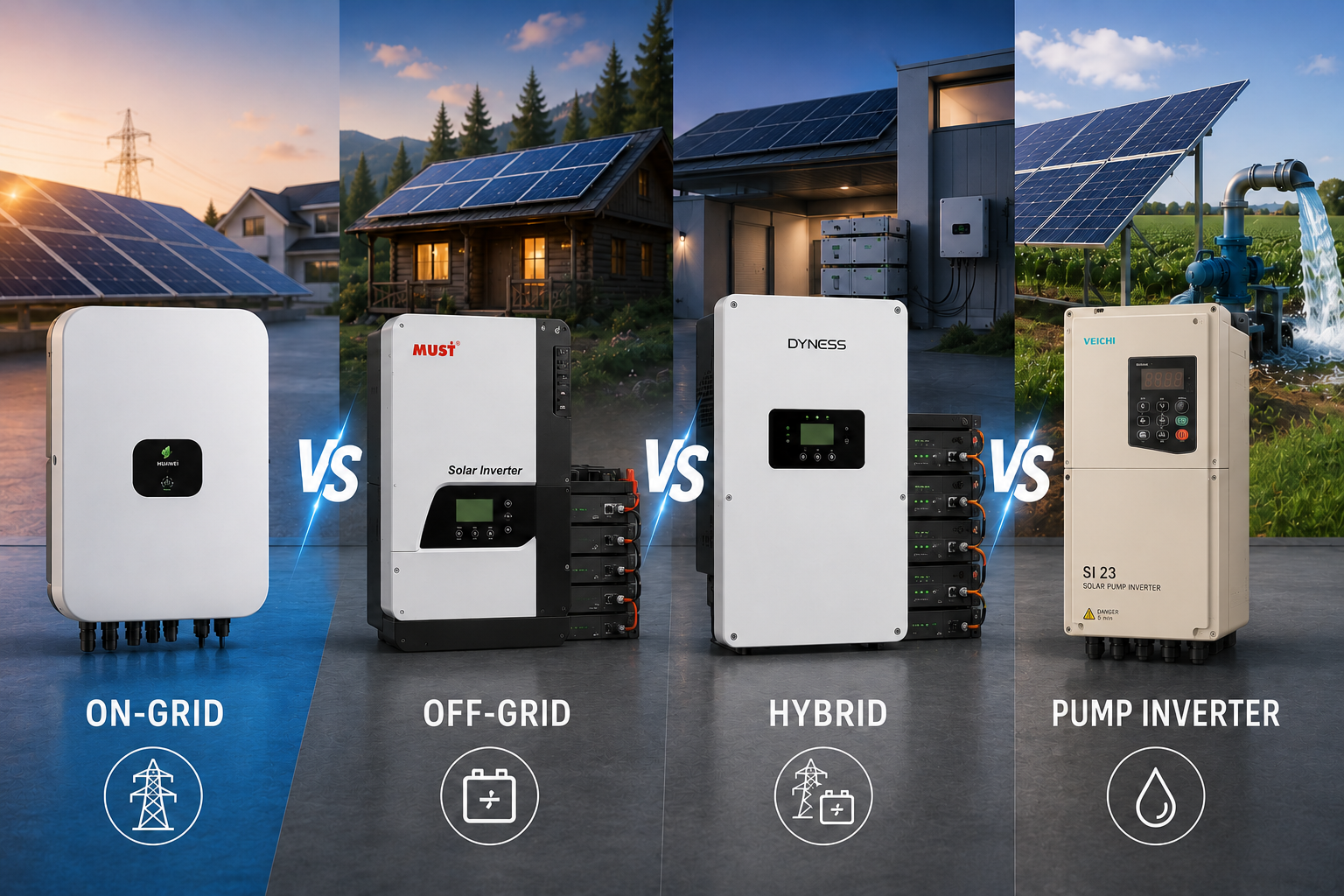
In this article we'll explain the 3 main types of inverters used in solar power.
First: On-Grid Inverters
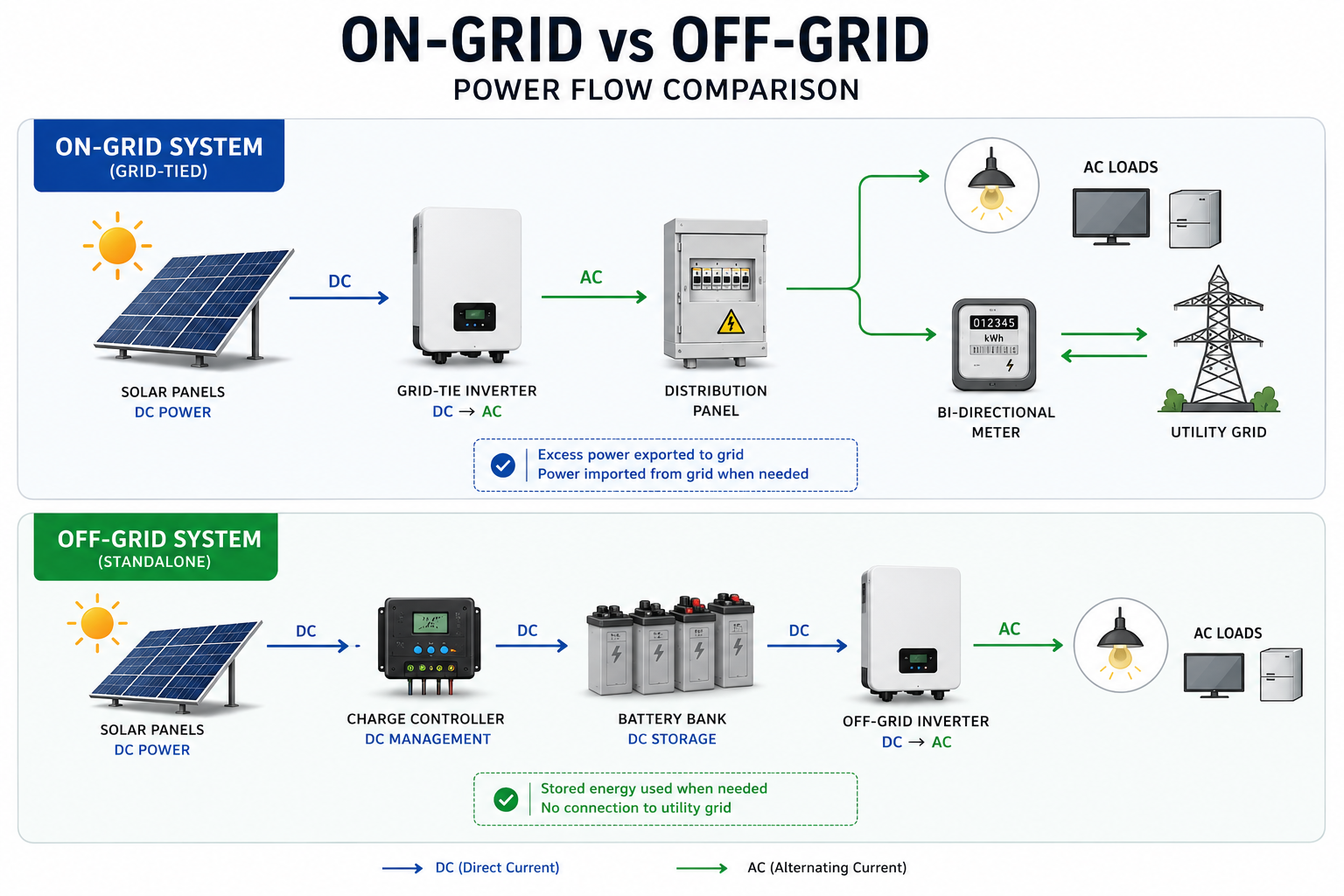
This type is designed for homes and factories already connected to the public electricity grid, and is currently the most common because it's the cheapest and simplest.
How does it work?
The inverter converts the panels' electricity to AC and feeds it directly into the home's system, with any surplus fed back to the public grid (if the system supports this and there's official net metering approved by the relevant authority). Most importantly: this system automatically shuts off if the public grid power goes out, a mandatory safety measure so that technicians repairing the grid stay safe.
Advantages:
The cheapest of all types.
Simple to install and maintain.
No batteries needed, which greatly reduces overall cost.
Disadvantages:
No electricity at all during a grid outage, even if the sun is shining, because it's designed this way for safety reasons.
Second: Off-Grid Inverters
This type is designed for places not connected to the public grid at all, like remote farms or far-off areas, or for anyone who wants complete independence from the electricity grid.
How does it work?
This system relies mainly on storage batteries. The inverter charges the batteries with surplus electricity during the day and draws power from them at night or during cloudy periods. The system is completely independent of any public grid.
Advantages:
Complete independence from the public grid.
An ideal solution for remote areas or places with no electricity at all.
Disadvantages:
Higher cost due to the batteries, which make up a large part of the system's cost.
Requires precise sizing of panels and batteries to cover your needs, especially on cloudy days.
Hybrid Type — An Important Point Worth Mentioning
There's a third type widely used now called the hybrid inverter, which effectively combines the advantages of both types: it works connected to the public grid like On-Grid, but comes with a battery like Off-Grid, so if the power goes out, it automatically switches to the battery within a fraction of a second to keep essential appliances running (like the refrigerator, lighting, and router). This is currently the most requested option for most homes in Egypt and Saudi Arabia due to its flexibility.
Third: Solar Pump Inverters
This type has a completely different purpose, because it's not designed to run household appliances or feed the grid — it's specifically designed to run water pump motors directly from the solar panels' electricity.
How is it different from the other types?
It converts the panels' DC electricity into AC electricity specifically for driving the pump motor directly, usually without needing any batteries at all.
It includes MPPT (Maximum Power Point Tracking) technology that helps it make use of every available watt from the panels, even during light cloud cover, by automatically adjusting the motor speed according to the amount of electricity available.
It's specifically designed to handle varying DC voltage and current throughout the day (lower in the morning and evening, higher at midday), something regular inverters aren't designed to handle.
Where is it typically used?
Agricultural irrigation in land far from the grid.
Supplying livestock with water in remote areas.
Groundwater wells in desert regions.
Quick Comparison Table
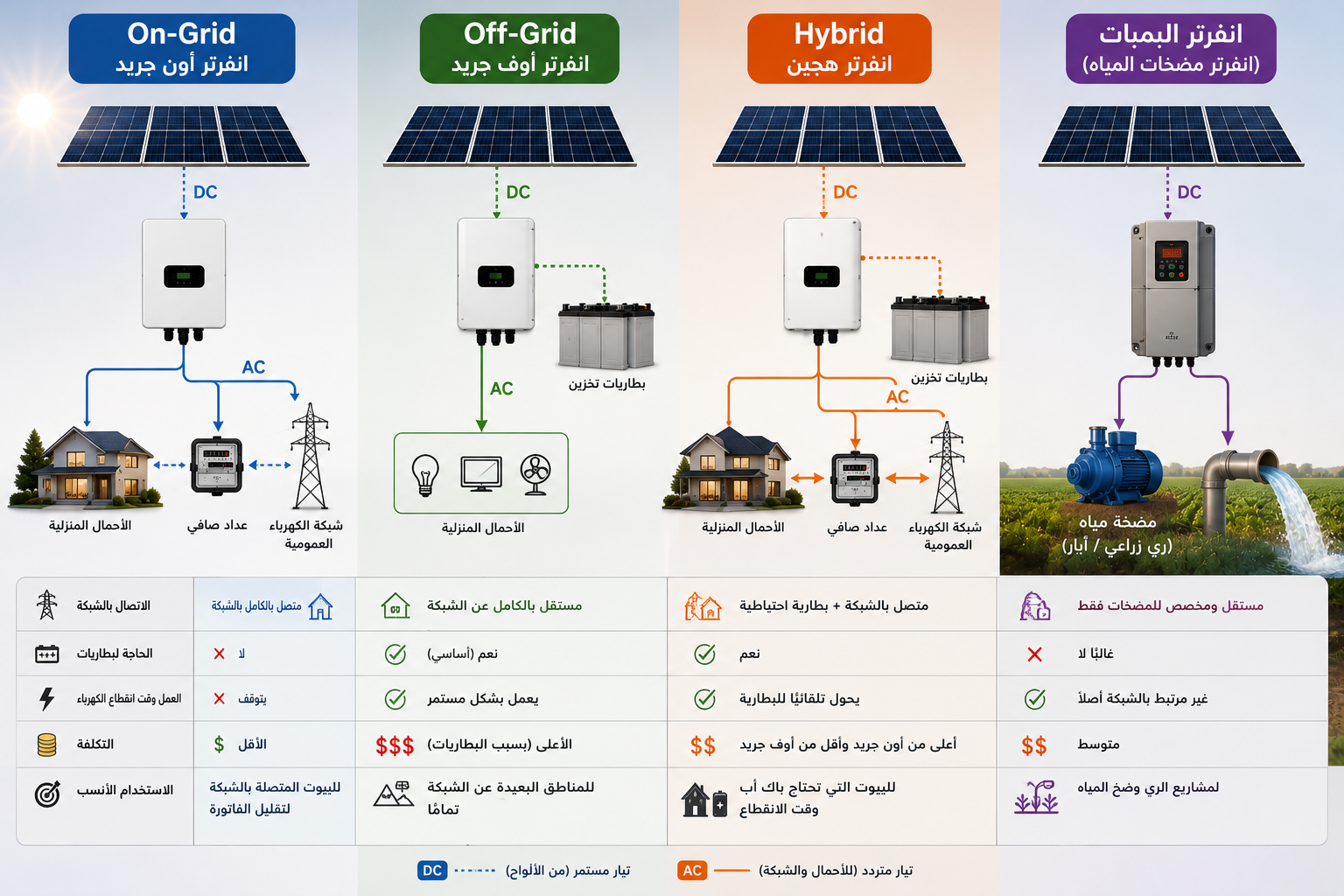
Grid connection: On-grid fully connected — off-grid fully independent — hybrid connected + battery backup — pump inverter independent and dedicated to pumps only
Need for batteries: On-grid no — off-grid yes, essential — hybrid yes — pump inverter usually no
Operation during a power outage: On-grid shuts off — off-grid operates continuously — hybrid switches automatically to battery — pump inverter isn't tied to the grid at all
Cost: On-grid the lowest — pump inverter medium — hybrid higher — off-grid usually the highest due to batteries
Best use: On-grid for grid-connected homes to reduce bills — hybrid for homes needing backup during outages — off-grid for areas completely away from the grid — pump inverters for irrigation and water pumping projects
Leading Manufacturers by Inverter Type
Solar Pump Inverter Companies:
Veichi – A globally known Chinese company in inverters and industrial motors, with a dedicated line of solar pump inverters using MPPT technology.
Frecon – A Chinese company specializing in VFD motors and solar pump inverters, with products widely used in agricultural irrigation projects around the world.
INVT – One of the largest Chinese companies in industrial control drives, with a dedicated line of solar pump inverters (such as GD100-PV) covering a wide range of capacities.
SAJ – A Chinese company, one of the oldest and largest global manufacturers of solar pump inverters, ranked among the top 3 brands in China's residential and agricultural markets.
Delixi – One of the major Chinese companies in electrical equipment and industrial motors, with a dedicated production line for solar pump inverters using MPPT technology.
On-Grid Inverter Companies:
Huawei – One of the largest inverter manufacturers globally, known for its high efficiency and smart monitoring system, with a strong presence in Middle East projects.
Sungrow – One of the largest and oldest inverter manufacturers in the world, with a broad presence in residential, commercial, and utility-scale solar projects.
Off-Grid and Hybrid Inverter Companies:
Veichi – In addition to pump inverters, it also has a strong production line for hybrid and off-grid inverters.
MUST – A Chinese company specializing in hybrid inverters, UPS systems, and lithium batteries, with a strong presence in Middle East and African markets.
Sako – Specializing in integrated systems (hybrid/off-grid inverter + lithium battery), with competitive prices and broad compatibility with different battery types.
Roughly How Much Does It Cost to Install Each Type in Egypt?
Cost varies depending on system size (in kilowatts) and the components used, but as a rough estimate common in the Egyptian market in 2026:
A 3-kilowatt on-grid system: Starts at roughly 45,000 to 60,000 Egyptian pounds.
A 5-kilowatt on-grid or hybrid system: Ranges roughly from 70,000 to 95,000 Egyptian pounds (without batteries), and increases if you add storage batteries.
A 10-kilowatt system: Ranges roughly from 150,000 to 190,000 Egyptian pounds.
The main cost difference between the types isn't really the inverter itself so much as whether or not batteries are added: hybrid and off-grid systems need storage batteries, which noticeably raises the total cost compared to a simple on-grid system without batteries.
These figures are estimates and vary depending on the dollar exchange rate and the chosen brand. Want an accurate quote tailored to your actual consumption? Contact us for a free site visit and to calculate the right capacity for your home or factory.
Frequently Asked Questions
Which type is best for a home in Egypt or Saudi Arabia with frequent power outages? The hybrid inverter is usually the best fit, since it gives you the electricity bill reduction advantage of on-grid, along with automatic backup during outages like off-grid.
Can I add a battery to a regular on-grid system later? In most cases, no — the inverter needs to be hybrid from the start or support battery addition, so if this is a future plan for you, ask the supplier upfront about upgrade support.
Can a pump inverter run household appliances other than the pump? No, it's specifically designed and calibrated to run the pump motor according to its specific specifications, and it's not a suitable solution for running regular household appliances.
Conclusion
Choosing the inverter type isn't a purely technical decision — it determines how you'll use the entire system. If your goal is to reduce your electricity bill while staying grid-connected, on-grid or hybrid are the best fit. If you need complete independence from the grid, off-grid is the solution. And if the project is for irrigation or water pumping, a dedicated pump inverter is the right choice, with no substitute offering the same efficiency and protection for the pump motor.