
 13 July 2026
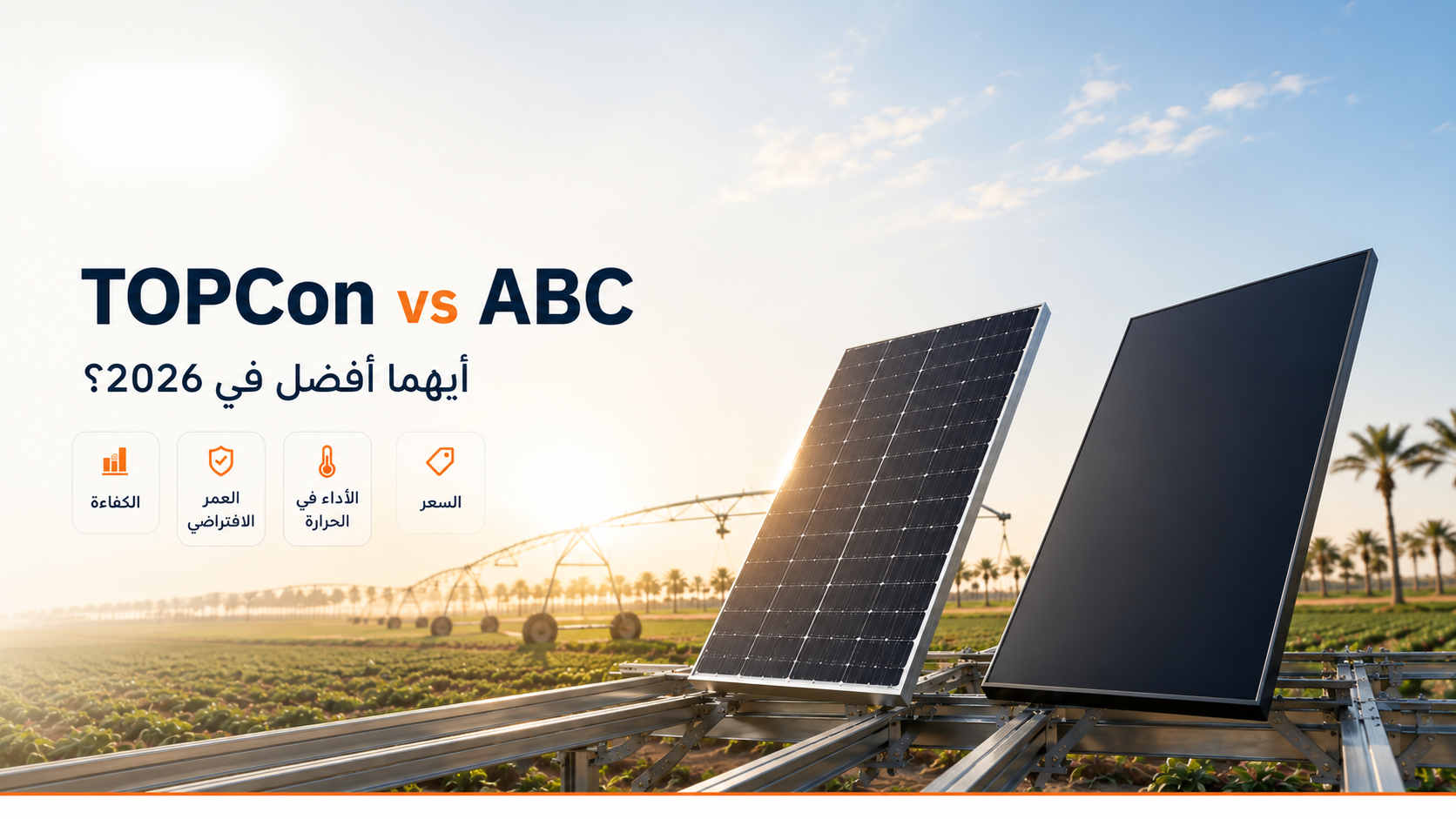
The Difference Between TOPCon and ABC Solar Panels: Which Is Better for Your Home or Factory?
Introduction: Why You Need to Understand the Difference Before You Buy
If you're thinking about installing solar panels for your home or factory, you'll likely hear two unfamiliar terms: TOPCon and ABC. These aren't brand names — they're manufacturing technologies used to produce the solar cell itself. Understanding the difference between them can save you a lot of money in the long run, because your choice will stay on your roof for 25 years or more.
Here's the thing that matters most: the price gap between the two technologies has become very small recently, to the point where it's almost negligible compared to the real difference in performance and lifespan between them. In practical terms, for nearly the same money, you can get a newer, stronger, and longer-lasting technology. In this article we'll explain why, simply and with real numbers, so you can make the right decision.
First: How Do We Actually Measure Solar Panel Quality?
Before we get into the details, there are only 3 points you need to focus on when comparing any two solar panels:
Efficiency: This is how much of the sunlight the panel actually converts into electricity. The higher the number, the more electricity the panel produces from the same area. Efficiency isn't just a catalog number — it determines how many panels you need to reach your desired consumption, meaning you could save on the number of panels, roof space, and wiring if you choose a higher-efficiency panel.
Durability and lifespan (annual degradation rate): Every solar panel loses a small percentage of its efficiency every year, and this percentage accumulates over 25 to 30 years. The difference between a panel that loses 0.35% per year and one that loses 0.5% can become a real difference in the electricity you draw from the grid after 20 years, not just a number on paper.
Price versus real value: The cheaper panel isn't necessarily the better value over the long run. If the price difference between two panels is small, and one of them gives you higher efficiency and a longer lifespan, then it's actually the cheaper option over 25 years, even if its purchase price is slightly higher.
Each of the two technologies we'll discuss affects these three points differently, and we'll explain that in detail with numbers.
What Is TOPCon Technology?
TOPCon stands for Tunnel Oxide Passivated Contact. You don't need to memorize the name — just understand the idea.
Think of a solar panel as having small "leaks" that waste part of the electricity that should be generated from light. TOPCon technology simply adds an extremely thin layer (hundreds of times thinner than a human hair) on the back of the panel. This layer seals those leaks and lets the panel make more efficient use of light.
Advantages of TOPCon:
High efficiency: Typically reaching around 22% to 24%, which is an excellent number.
Relatively low degradation rate: Modern TOPCon panels lose about 0.35% to 0.4% of their efficiency each year, a major improvement over older technologies like PERC.
Good warranty: Major manufacturers guarantee the panel retains about 87% of its original efficiency after roughly 30 years.
Widely available: Most major manufacturers worldwide now produce it, so it's widely offered and maintenance and warranty support is easier.
Handles heat well: Important for our climate in Egypt and Saudi Arabia — its temperature coefficient is about -0.29%/°C, meaning it loses only a small part of its efficiency as temperature rises.
What Is ABC Technology?
ABC stands for All Back Contact, which literally means "all connections on the back."
To understand it simply: in regular panels, thin visible metal lines run across the front surface — these lines carry the electricity, but they also block a small part of the sunlight. ABC technology solves this cleverly by moving all these connections entirely to the back of the panel, so the front surface becomes completely clean and receives all the light with no blocking at all.
Advantages of ABC:
The highest efficiency currently available: Reaching 24% to 26%, the highest commercially available percentage right now in silicon panels, meaning more electricity output from exactly the same area.
Slower degradation and longer lifespan: ABC panels lose only about 0.35% of their efficiency annually, retaining more than 88% to 90% of their original efficiency even after 30 years of operation. This difference looks small as a number, but it accumulates over the system's lifetime and translates into more real electricity in your pocket over the long run.
Better heat tolerance: Its temperature coefficient is about -0.26%/°C, better than TOPCon, which matters a lot in our summer heat in Egypt and Saudi Arabia because it reduces losses at midday.
Excellent performance in partial shade: If part of the panel is shaded (by a tree, chimney, or nearby building), the panel can isolate just that part without it affecting the rest of the panel, which can provide significantly higher output compared to traditional panels under the same conditions.
Higher durability and better crack resistance: Because the connections aren't on the front surface, the panel is less prone to wear and damage from dust, humidity, and weather changes over time.
Premium aesthetic look: The front surface is smooth and uniform with no visible lines, suiting projects that care about appearance, like villas and facades.
Better performance in low light: Meaning early morning or cloudy conditions, the panel keeps producing electricity at relatively higher efficiency.
And what about the price?
The precise manufacturing required for ABC technology initially made it noticeably more expensive than TOPCon. But with major companies like Aiko entering mass production, the price gap between the two types has shrunk dramatically in recent times, and in many cases it's now a very small difference, almost negligible compared to the real gap in efficiency and lifespan. In practical terms: for nearly the same money, you get higher efficiency, longer lifespan, and better heat and shade resistance. This is why many industry specialists now see ABC as the natural next step after TOPCon, not just a pricier alternative.
One thing to keep in mind:
The number of manufacturers is still limited: This technology is newer and harder to manufacture, so not all companies produce it, meaning your supplier options will be fewer than with TOPCon — so make sure you're dealing with a trusted supplier who has spare parts and real local warranty support.
Quick Comparison Between TOPCon and ABC
Efficiency: TOPCon about 22% to 24% — ABC about 24% to 26%
Annual degradation rate: TOPCon about 0.35%-0.4% — ABC about 0.35% with generally better retained efficiency
Remaining efficiency after 30 years: TOPCon about 87% — ABC about 88%-90%
Temperature coefficient: TOPCon about -0.29%/°C — ABC about -0.26%/°C (better)
Price: The gap between them has shrunk dramatically and is now very small
Appearance: TOPCon has visible connection lines — ABC has a completely clean surface with no lines
Performance under partial shade: TOPCon average — ABC excellent
Manufacturer availability: TOPCon very widespread — ABC relatively limited but growing steadily
Leading Manufacturers of Each Technology
Companies well known for manufacturing TOPCon panels:
Jinko Solar – One of the largest manufacturers in the world, with a strong presence in the Egyptian and Saudi markets.
LONGi Solar – A global leader in TOPCon technology, known for quality and wide distribution.
Trina Solar – One of the oldest and largest companies in the solar industry, with a strong presence in the Middle East.
JA Solar – A well-known and trusted name in the market, exporting its products to many countries in the region.
Canadian Solar – A globally recognized company offering TOPCon panels with good quality and warranty.
Risen Energy – A company that has expanded strongly in TOPCon panel production recently.
Companies well known for manufacturing ABC panels:
Aiko Solar – The global leader in ABC technology, with its Neostar series among the highest-efficiency panels currently on the market.
Maxeon Solar Technologies – A veteran American company (an extension of the SunPower brand), known for premium Back Contact panels with long-term quality and warranty.
The number of companies manufacturing ABC is still small compared to TOPCon, because this technology is newer and harder to produce. This means your choices in the Egyptian or Saudi market will be much wider if you go with TOPCon.
Which Is Better Suited to the Climate in Egypt and Saudi Arabia?
Our region's climate is defined by two important factors: high heat most of the year, and high levels of dust. These two factors specifically favor ABC, because its heat tolerance is better, and its design without visible front lines reduces dust buildup on specific parts of the panel.
TOPCon remains a strong, reliable choice, especially if your priority is the widest possible range of suppliers and brands immediately available in the local market.
ABC is now the smarter choice for most people, not just premium project owners. Since the price gap with TOPCon has become very small, you're effectively paying roughly the same amount for higher efficiency, better heat tolerance, and a longer lifespan. Roughly the same investment, but with a bigger return over the next 25 to 30 years.
Bottom line for choosing: If the price difference with your supplier is small (which is the prevailing situation in the market right now), ABC is the more logical choice long term. If there's a real, significant price gap beyond your budget, TOPCon remains an excellent, reliable alternative.
Frequently Asked Questions
Is TOPCon an older technology compared to ABC? No, both technologies are modern, but ABC was developed a bit later and is currently considered the latest step in the evolution of silicon panels.
Are ABC panels worth the price difference? Yes, and the answer is clearer than ever. The price gap between ABC and TOPCon has shrunk significantly recently, and in many cases it's now very small. For a small material difference, you get higher efficiency, a longer lifespan, and better heat tolerance, making it a smarter investment for most people, not just premium project owners.
Do ABC panels really last longer than TOPCon? Yes, the difference is real and documented. ABC panels retain about 88% to 90% of their original efficiency after 30 years, compared to about 87% for TOPCon panels. The difference looks small as a number, but it accumulates year after year and translates into real additional electricity over the system's lifetime.
Does the warranty differ between the two types? Warranty depends on the specific manufacturer rather than just the technology, but in general, major ABC manufacturers offer strong performance warranties reaching up to 30 years. It's always important to confirm the warranty terms clearly with your supplier before buying, in either case.
Conclusion
Both technologies are excellent, and each has genuinely improved on the generations before it. But the full picture in 2026 has become clear: the price gap between TOPCon and ABC has become very small, while the difference in efficiency, degradation rate, heat resistance, and lifespan clearly and documentedly favors ABC. This means ABC has effectively become the better value for money for most projects, not just a luxury for those who can pay more.
TOPCon remains a trusted, excellent choice, especially if you need more flexibility in choosing suppliers or have a very large-scale project. ABC, meanwhile, is the technology that delivers the highest real return on your investment over 25 to 30 years, for a small price difference that's disproportionate to the size of the gap in performance and lifespan.
More important than the technology itself is choosing a trusted, certified supplier, because installation and maintenance quality affects the performance of any solar panel regardless of the technology used.